
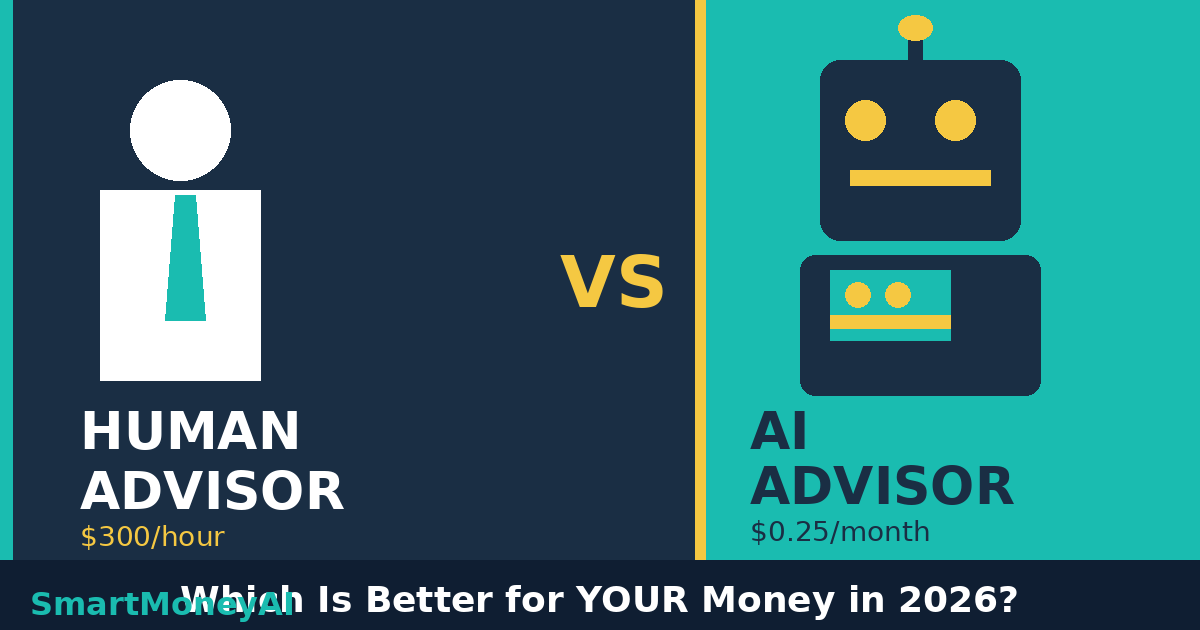

You’re sitting across from a financial advisor who charges $300 an hour. They ask about your goals, nod thoughtfully, and hand you a generic portfolio recommendation you could have Googled yourself. Sound familiar? Meanwhile, an AI robo-advisor is managing someone else’s $50,000 portfolio for $3 a month — automatically rebalancing, tax-loss harvesting, and optimizing returns around the clock. So which is actually better? The answer might surprise you.
What Human Financial Advisors Actually Do
A good human financial advisor does a lot more than pick stocks. They help you navigate complex life events — divorces, inheritances, business sales, estate planning — where emotions, taxes, and legal considerations all intersect. They ask the questions you haven’t thought to ask and talk you off the ledge when the market drops 20% and you want to sell everything.
What human advisors are great at:
- Complex financial planning (estate planning, tax strategy, business succession)
- Behavioral coaching — stopping you from making emotional decisions
- Holistic life planning — integrating finances with your actual goals
- Navigating major life transitions (divorce, retirement, inheritance)
- Accountability — someone who knows your name and checks in on you
What human advisors are NOT so great at:
- Consistency — humans have bad days, biases, and blind spots
- Availability — you can’t call your advisor at 2am
- Cost — fees ranging from 0.5% to 2% annually can cost you tens of thousands over a lifetime
- Conflicts of interest — some advisors earn commissions for recommending certain products
What AI Financial Advisors Actually Do

AI-powered financial tools — also called robo-advisors — use algorithms to manage your investments automatically. They’re not guessing or going with their gut. They’re processing thousands of data points every second to optimize your portfolio based on your goals, risk tolerance, and time horizon.
What AI advisors are great at:
- Low cost — most charge 0.25% or less annually, compared to 1%+ for humans
- Consistency — no emotions, no bad days, no conflicts of interest
- 24/7 availability — your portfolio is being managed while you sleep
- Automatic rebalancing — keeps your portfolio aligned with your goals without you lifting a finger
- Tax-loss harvesting — automatically selling losing investments to offset tax bills
- Accessibility — anyone can start with as little as $1
What AI advisors are NOT so great at:
- Complex situations — AI struggles with nuanced life events that require human judgment
- Emotional support — an algorithm won’t talk you through a financial crisis
- Customization — most robo-advisors offer limited personalization beyond risk tolerance
- Relationship — there’s no human who knows your full story
The Cost Comparison: This is Where It Gets Interesting

Let’s talk real numbers. Say you have $100,000 invested.
- Human advisor at 1% annually: $1,000/year in fees
- AI robo-advisor at 0.25% annually: $250/year in fees
- Difference over 30 years (assuming 7% annual returns): The fee difference alone costs you over $100,000 in lost compound growth
That’s not a typo. A 0.75% difference in fees can cost you six figures over a lifetime of investing. This is why fee-conscious investors are increasingly turning to AI tools for the bulk of their portfolio management.
Top AI Financial Advisor Tools in 2026

1. Betterment
Best for: Hands-off investing and retirement planning
Fee: 0.25%/year
Betterment is the gold standard of robo-advisors. It automatically builds a diversified portfolio, rebalances it, and performs tax-loss harvesting — all for a fraction of what a human advisor costs. Their premium tier connects you with human advisors for complex questions.
2. Wealthfront
Best for: Automated financial planning and tax optimization
Fee: 0.25%/year
Wealthfront goes beyond investing — it creates a full financial plan that integrates your retirement accounts, home equity, and other assets. Their Path tool uses AI to show you exactly when you can retire based on your current trajectory.
3. Schwab Intelligent Portfolios
Best for: Zero-fee automated investing
Fee: $0 (no advisory fee)
Charles Schwab’s robo-advisor charges absolutely nothing in advisory fees. It automatically invests in a diversified portfolio of ETFs and rebalances automatically. The catch? You need $5,000 to get started.
4. Magnifi
Best for: AI-powered investment research and stock screening
Fee: Free to $14.99/month
Magnifi is an AI investment assistant that lets you search for investments using natural language. Ask it “show me clean energy ETFs with low expense ratios” and it delivers. It’s like having a research analyst available 24/7.
5. Personal Capital (Empower)
Best for: Hybrid AI + human advisory
Fee: 0.49%–0.89%/year
Personal Capital bridges the gap between AI and human advisors. Their free dashboard gives you a complete picture of your finances using AI, while their paid wealth management service pairs you with dedicated human advisors for larger portfolios.
So Which Is Actually Better?

Here’s the honest answer: it depends on where you are in your financial journey.
- Just starting out (under $100K): AI wins. The cost savings alone justify using a robo-advisor. Use Betterment or Wealthfront and invest the fee savings.
- Growing wealth ($100K–$500K): AI for investments, human for planning. Use a robo-advisor for your portfolio but consult a fee-only human advisor once or twice a year for complex decisions.
- High net worth ($500K+): Consider a hybrid approach. The complexity of your finances likely justifies a human advisor, but they should be working alongside AI tools, not instead of them.
- Major life event: Always talk to a human. Divorce, inheritance, selling a business — these require human judgment, empathy, and legal expertise that no algorithm can replace.
The Future: AI and Human Advisors Working Together

The smartest financial advisors in 2026 aren’t competing with AI — they’re using it. The best human advisors now leverage AI tools for portfolio analysis, tax optimization, and market research, freeing up their time to focus on what humans do best: understanding your life, your fears, and your goals.
The question isn’t AI vs human anymore. It’s: are you using the best tools available to you? Because whether it’s a robo-advisor managing your ETFs or a CFP helping you navigate a complex estate, the goal is the same — building a financial future that gives you freedom and peace of mind.
And that’s exactly what SmartMoneyAI is here to help you do.
Disclaimer: This content is for informational and educational purposes only and does not constitute financial advice. Always consult a licensed financial advisor before making investment decisions.
Want more AI money tips delivered weekly? Subscribe to the SmartMoneyAI newsletter and stay ahead of the curve.