
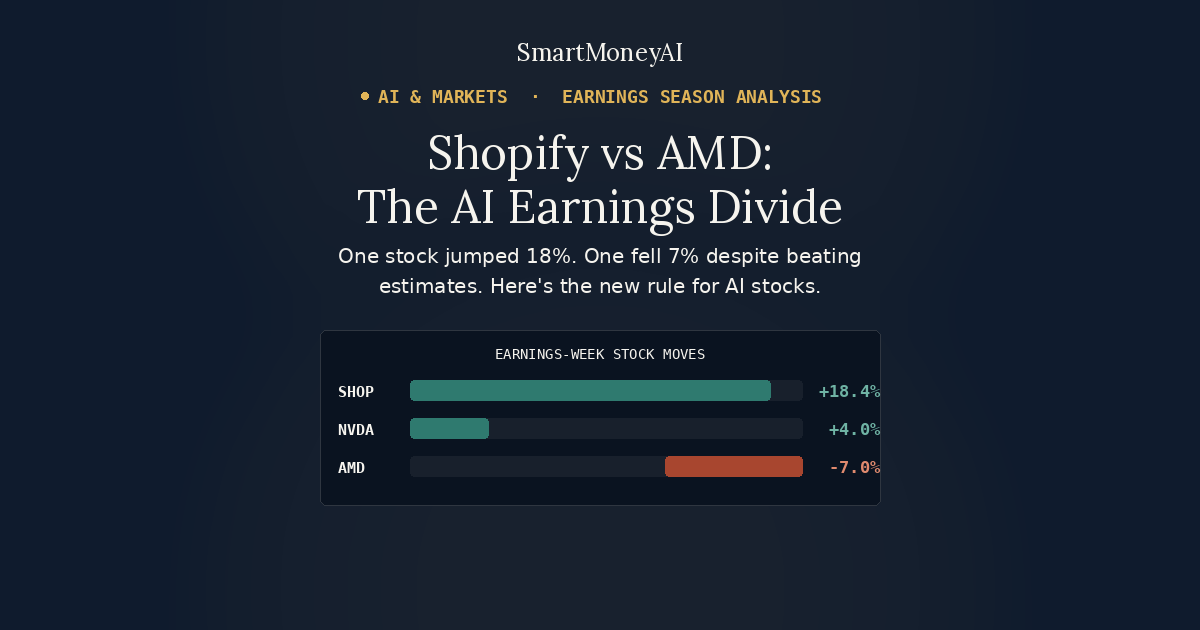
Same Week, Same “AI Story” — Shopify Jumped 18% and AMD Fell 7%
Both companies beat earnings. Only one got rewarded. Here’s the line Wall Street is now drawing through every AI-related stock this earnings season — and how to spot which side of it a company sits on.
Two earnings reports, four days apart, tell you almost everything about how Wall Street is scoring the AI trade right now. Shopify beat estimates and its stock jumped 18% in a single session. AMD also beat estimates — a record quarter, revenue up 50% — and its stock fell 7% the same week. Same broad theme in both reports. Opposite market reaction. That’s not noise. It’s a pattern, and it’s worth understanding before you look at any AI-adjacent stock in your own portfolio.
01 — The two reportsWhat actually happened
Shopify’s second-quarter numbers were strong on their own — revenue up 34% to $3.58 billion, gross merchandise volume climbing 30% to $115.6 billion, a sixth straight quarter above 30% growth. But the number that moved the stock wasn’t the top line. Management’s presentation leaned hard on what it called “agentic commerce”: AI tools, including its Sidekick assistant, that the company said were driving measurably more orders and faster customer acquisition, with next-quarter guidance raised above what analysts expected. In plain terms, Shopify showed investors a direct line from AI spending to more revenue, not just more cost.
AMD’s quarter, on paper, was arguably just as good. Revenue hit $11.5 billion, up roughly 50%, with earnings per share of $1.66 beating the $1.60 consensus. But on the same earnings call, SpaceX’s Elon Musk told analysts that SpaceX would build its AI computing infrastructure exclusively on Nvidia going forward — a reversal from his earlier comments that SpaceX and Tesla would keep buying from both companies. AMD’s own numbers barely mattered after that. The stock dropped as much as 10% intraday before settling down around 7%, while Nvidia, the beneficiary of the exclusivity, rose about 4%.
Shopify (SHOP)
Revenue $3.58B (beat). AI-driven order growth cited directly in guidance raise. Multiple analyst upgrades followed within 48 hours.
AMD
Revenue $11.5B, up ~50% (beat). Stock fell anyway after losing a marquee AI infrastructure customer to a rival, on the same call.
02 — The patternMonetization vs. spending promises
Zoom out and this isn’t really a Shopify-versus-AMD story. It’s the clearest example yet of a distinction Wall Street has been drawing all earnings season: companies that can show AI turning into revenue today are getting rewarded, sometimes generously. Companies whose AI story is still mostly about capital expenditure — building data centers, buying chips, promising future capacity — are getting scrutinized much harder, even when the underlying numbers are good.
After roughly two years of the market rewarding almost any AI capex announcement on faith, investors are increasingly asking the follow-up question: where’s the revenue? A Bloomberg Intelligence analyst covering Shopify’s results noted that investors had actually expected AI-related spending to squeeze margins this quarter — instead, operating expenses came in slightly below forecasts while growth accelerated, which is close to the best-case outcome a market skeptical of “spend now, monetize later” stories could ask for.
Sorting this earnings season’s AI stories
| Company | The AI story | Category |
|---|---|---|
| Shopify | AI tools cited as direct driver of order growth and raised guidance | Monetization |
| Nvidia | Won exclusive supply deal; demand proof point, though from a customer’s spend | Monetization-adjacent |
| AMD | Record revenue, but the market focus was a lost future customer and rising capex | Spending / capex |
| SpaceX (AI infra unit) | $18.4B in capex last quarter, ~$15.8B directed to AI computing, revenue-generation still early | Spending / capex |
Worth being precise here: “spending” isn’t automatically a red flag, and “monetization” isn’t automatically a green light. AMD’s underlying business is still growing fast, and infrastructure buildouts like SpaceX’s are a normal, even necessary, phase before monetization shows up. The point isn’t that one category is right and the other wrong — it’s that the market’s patience for the “trust us, it’ll pay off eventually” story is visibly shorter than it was a year ago, and that’s changing which earnings reports move stocks and by how much.
03 — What this means for your portfolioBefore you chase either headline
-
1Don’t extrapolate one earnings reaction into a ruleA single quarter’s stock move tells you what the market cared about that day, not a durable law about AI monetization versus AI spending.
-
2Separate the fundamentals from the headlineAMD’s actual results were strong. If you own it, the quarter itself isn’t the reason it fell — the lost customer narrative is. Those call for different levels of concern.
-
3Watch this week’s earnings through the same lensSuper Micro Computer and Cardinal Health report Tuesday, Applied Materials Thursday. Ask the same question of each: is the AI story about revenue already showing up, or capacity being promised?
-
4Check concentration, not just convictionIf your portfolio leans toward AI infrastructure names specifically, this week is a reminder that a single customer comment can move a stock more than the quarter’s actual numbers.
04 — Using AI tools to screen for thisAsk your platform the sorting question directly
This is a genuinely useful screen to run through an AI research or portfolio tool, if yours supports natural-language queries against your holdings or a watchlist. Rather than asking something vague like “is AI a bubble,” ask it to actually sort:
“Of the AI-related companies in my portfolio or watchlist, which ones report AI-driven revenue growth in their most recent earnings, versus which ones are mainly describing AI capital expenditure without disclosed revenue impact yet?”
A tool that can pull recent earnings language and actually categorize your specific holdings that way is doing something a keyword stock screener can’t. One that comes back with a generic explainer on AI investing instead is, again, a useful signal about how much is really happening under the hood.
The honest takeThis divide will probably keep sharpening
If there’s a single takeaway from this week, it’s that “AI exposure” stopped being enough on its own to move a stock in one direction. The market increasingly wants to know which side of the ledger a company’s AI story sits on — money coming in, or money going out with a promise attached. That’s a healthier dynamic than blanket enthusiasm, even though it makes individual earnings reports more volatile and harder to predict in advance. Expect more sessions like this one before the market settles into a stable view of who the real AI winners are.
Leave a Reply